Creatively Mothers Day
A Designer’s First Look: Warm, Hand-Drawn Charm with Purpose
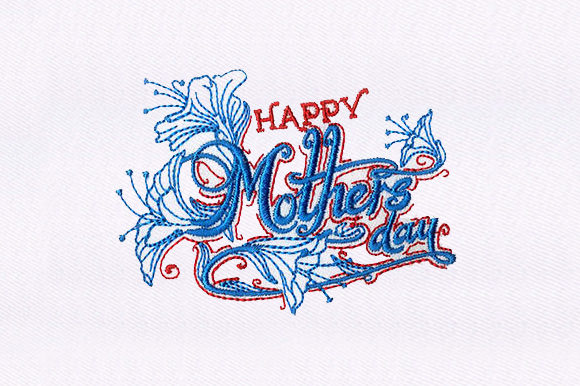
When Creatively Mothers Day opened in my embroidery software, I paused—not because it’s flashy, but because it *feels* intentional. The layout is centered and balanced within the 4×4 hoop (3.75″ × 2.84″), with soft curves, slightly uneven lettering, and subtle floral accents that lean into handmade warmth rather than digital perfection. It’s not a bold script or a minimalist monogram—it’s a quiet celebration: gentle, sincere, and designed to land softly on fabric. That tone matters. If you’re stitching for a boutique baby blanket, a linen tea towel for a local gift shop, or a personalized sweatshirt for a client’s mom, this design doesn’t shout—it invites.
Where It Shines: Real Projects, Real Customers
I tested Creatively Mothers Day on three real-world items: a medium-weight cotton tote bag, a midweight French terry sweatshirt, and a 100% cotton kitchen towel. On the tote, the satin-stitched outlines held crisp definition, and the fill stitches settled smoothly without puffing—even with standard tear-away stabilizer. On the sweatshirt, I added light cutaway underneath, and the design retained its airy feel without sinking into the pile. Most telling? A customer who saw the towel mockup said, “That looks like something my daughter would make me.” That’s the sweet spot: Creatively Mothers Day reads as thoughtful, not mass-produced.
It works especially well for small-batch makers—Etsy sellers offering custom embroidered gifts, craft fair vendors building seasonal collections, or small shop owners curating Mother’s Day bundles. As a machine embroidery design, it scales cleanly across product types: embroidered patch (stabilize tightly and trim close), pillow cover (test corner tension first), apron pocket (centered placement feels natural), and even baby onesies (use lightweight stabilizer and reduce top tension slightly).
Fabric & Fit: Know When to Lean In—and When to Pause
This isn’t a one-size-fits-all embroidery file. Its 9,278 stitches are thoughtfully distributed, but density clusters near the floral flourishes and lower curve of the “y” in “Day.” On thin or highly textured fabrics—like slubbed linen or loosely woven gauze—I recommend testing with reduced stitch density or switching select fills to a lighter underlay. Stretchy knits need extra care: use a firm cutaway stabilizer and consider slowing your machine speed by 15–20% to prevent skipped stitches in those delicate curves.
Dark fabrics demand attention too. The design relies on contrast—especially in the fine running-stitch details—to read clearly. On navy or charcoal, I swapped to a cream or pale gold thread and confirmed legibility in a black-and-white printable mockup before stitching. And while it fits neatly in a 4×4 hoop, don’t force it onto curved surfaces like structured caps without digitizing adjustments—the side curves may distort the letter spacing.
What Makes It Feel “Finished”—Not Just Stitched
Creatively Mothers Day earns trust because it balances detail with restraint. There’s no over-engineered applique design here—just clean satin borders, breathable fill areas, and intentional negative space. That breathability translates directly to perceived value: customers associate tidy stitch clarity with craftsmanship, not automation. For handmade product listings, it elevates presentation without requiring complex finishing. On an Etsy product page, pairing it with a simple linen pillow cover and warm natural lighting reinforces authenticity—no stock photo needed.
It also supports brand consistency. Whether you’re a solo maker or a small team, using Creatively Mothers Day across multiple Mother’s Day items—tote + towel + baby onesie—creates visual cohesion without repeating the same motif. That repetition feels curated, not repetitive.
Designer Notes You’ll Actually Use
- Always test first—run it on scrap fabric matching your final project’s weight, stretch, and color.
- Check thread colors against your base fabric in natural light—not just screen preview. Small variations matter in satin stitch sheen.
- Review stitch density in your software: look for tight clusters near floral elements and adjust if needed for delicate fabrics.
- Confirm hoop size compatibility: this is a 4×4 design—verify your machine’s max hoop capacity and whether rotation or rehooping is needed for multi-position projects.
- Inspect small details at 200% zoom: the dot above the “i” and petal tips should be fully stitched, not lost in underlay.
- Test black-and-white mockups to assess contrast and hierarchy—this design lives or dies by readability.
- Use appropriate stabilizer: tear-away for stable wovens, cutaway for knits, and lightweight fusible for sheer layers.
- Verify licensing before selling finished products or bundling the embroidery file digitally—check terms for commercial embroidery and resale rights.
Final Thought: A Design That Serves the Moment
Creatively Mothers Day isn’t about trend-chasing. It’s about resonance. It works because it respects the person receiving the gift—and the maker putting time, thread, and intention into it. In a crowded market of holiday embroidery files, this one stands out by staying grounded: no excessive bling, no forced whimsy, just sincerity stitched with care. For craft business owners, Etsy sellers, and designers building meaningful inventory, it’s not just another machine embroidery design—it’s a reliable, emotionally intelligent asset. Use it where warmth matters most. And always, always stitch it like someone’s going to hold it, smile, and say, “She made this just for me.”